Monday, January 23, 2006

Ordinary peace

Violence was almost unheard of when Helena Norberg-Hodge began studying the Ladakhi in the 1970's. (See Learning from Ladakh.)


How do we create that kind of everyday joy in our lives today? How do we create the peaceful life of the Village of Ordinary?


Compassion, the Dalai Lama tells us, is the path to peace.


If this is true, do we have to have compassion for everyone? Can we only be at peace when we love the most egregious murderer/torturer?


Where lies compassion for one who would kill and torture for greed or power? How do we love a man like Clarence Ray Allen (see Why do we kill people) or the grandfather who molested, or the president who started a killing war with lies?


We can only, as Pema Chadron says, start where we are.


Every single day, in tiny ways, we must begin again, right where we are, to make peace.


So for everyone reading this and puzzling how to develop compassion for the back-stabber at work, the spouse who cheated then got a better lawyer and took everything, the dictator who used biological weapons on his own people, the murderer and rapist, perhaps Clarence Ray Allen, here are two tips for growing compassion and peace in your heart and life.


Start where you are tip:

Try smiling at every person you meet for an entire day.

I guarantee you will be surprised at the difference it makes.

Come back here after you've tried it and tell the rest of us what you experienced.


Growing compassion tip:


Listen to people apologizing for almost anything including, yes, murder in Act 2 of This American Life's November 5, 2004, show Apology. (You will need to select "o4" from the sidebar menu, then scroll down a few episodes to "Apology.")


Come back here afterward and enter a comment about what you felt for and what you learned.


Lastly, don't forget that smile at home, where peace begins.

Wednesday, January 18, 2006

Why do we kill people? Yup, this one hurts

Why do we kill people who are killing people to show that killing people is wrong?

Holly Near, Entertainer, Teacher, Activist


The State of California killed another man this week.

Clarence Ray Allen was convicted of killing a lot of people. He set up some of the murders from his prison cell.

From the news reports, it appears that he was a cowardly, ignoble, disgraceful example of the human race who did nothing to redress his wrongs or show remorse for his actions. In fact, he seems to have gone to his death proud of his life work.

Reading Allen's story, I am hard put not to feel hatred for him. My personal ethics are sorely tested.

Still, if I judge Allen for his heinious crimes, so must I judge myself, for there is no good killing, and the State of California, my state, killed him in my name, and in yours, if you live here.

There is more to it than that, though.

Somewhere along the way we, the global family of Clarence Ray Allen, failed him. We failed because we did not meet the fundamental needs of the child who grew up to kill.

One of the guiding principles of Ordinary is that every child is wanted, welcomed, and nurtured throughout her lifetime. Every child deserves to be loved and raised in a healthful, peaceful environment.

Such children grow up to be strong, responsible, nuturing adults possessed of the capacity to give more than they receive.

It is our responsibility--yours and mine--to create that environment so that no more children become adults with a desire or need to rob, torture, or kill.

The task is daunting. I am only one person. You are only one person.

Neither you nor I have a right to stop before we begin just because the task is overwhelming.

Pema Chadron tells us, start where you are.

So I begin, and I urge you to begin, by making peace in your life every tiny step of the way.

At work when conflicts rise, at home when the dishes pile up, at weddings, funerals, and holidays when family get-togethers revive unresolved pain and suffering, take timeouts, breathe, dig deep in your heart for compassion.

Do whatever it takes to turn that moment of conflict and suffering to peace.

Most especially, if you have children, teach them through your example how to live peaceably in the world, how to respond with forgiveness, understanding, compassion, and love.

Sunday, October 16, 2005

Building with earth - ancient technology solving today's problems

Wanda Tucker (see comments under Evening Replay on October 6) intriguingly suggests that the semi-circular structure of the apartment complex in Jasper is reminiscent of the architecture of sites such as Chaco Canyon.

Wonderful idea! I am certainly influenced by the builders of Chaco and Mesa Verde, as well as by the mud-brick buildings of the Middle East, some of which have been standing for thousands of years.

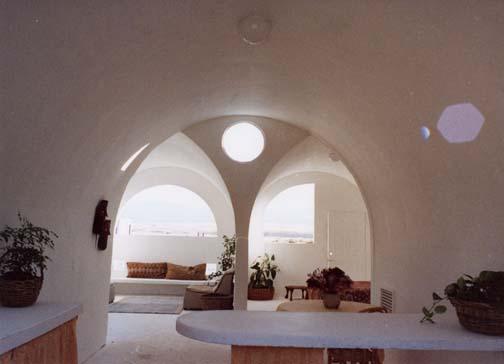
The sensual properties of earthen structures, their graceful lines and earthy scent, nurture the body and spirit.

More, adobe, strawbale, and cob buildings withstand hurricanes and earthquakes very well.Materials are cheap and at hand, and anyone with a strong back can build them.

Interior image of Superadobe home from www.cal-earth.org website

The architect Nader Khalili, who has designed habitat for future NASA moon missions, has designed ingenious emergency housing, as well as beautiful homes such as the one in the photo to the left, and public facilities using earth rammed in sand bags. He calls his structures superadobe.

The technology to live gracefully, in harmony with Earth, in deeply comfortable and less costly environments exists today, as it has for millenia.

Earthen structures work well in a variety of climes. I first learned of cob when I read of a six-hundred year old cob house in England. They've been building them there for centuries. See these photos.

There is at least one cob house in rainy Oregon, and some folks in British Columbia give regular classes on building cob there. A good example is Kate's Cob - Mayne Island B.C..

Photo from Groundworks web site at www.cpros.com/~sequoia/cobhome.jpg

To learn how easy--or difficult--it is to build a cob home, check out the tale of this 72-year-old woman, Lois Lewis, who built her own home.

For a capsule view of cob use, read Michael Smith's essay, The History of Cob at Natural Building Colloquiem Southwest.

Thursday, October 06, 2005

Evening replay

It seems I cannot move forward with Rose's next post until I noodle more with Evening. I'm not happy with it--the tempo is off. It's way too long. On reflection, an apartment complex constructed in concentric circles would take too much land, especially on a hillside sloping to a lake. Views would be lost.

The complex needs to be airy, open, and bring more of the forest from which it was hewn into the lives of the folk living there.

S suggests cutting the circles in half.

Of course! Arcs solve so many problems in architecture as well as landscaping. They evoke the circle, wholeness, openness to possibilities, to wind, to storm, to laughter. Arcs embrace without excluding. Thank you, S.

It may be a while before Evening lets me go.

Sunday, September 11, 2005

Gaviotas - A real village

Ordinary exists! Or something very like it, and in the most inhospitable of places--Colombia.

Thirty-some years ago, Paolo Lugari, a native Colombian and son of an Italian immigrant, founded Gaviotas in the broad, inhospitable savannah of Colombia where soil is too full of iron to support food crops and the water table so deep that native populations were forced to drink fetid water much of the year.

At that time, water-borne bacteria killed more people in the savannah than the military, narctoics trafficers, and guerillas combined.

Gaviotas soon became a model experimental community of sustainability, cooperation, and ingenious inventions, including deep wells pumped by children riding teeter-totters, that are being used throughout the world to better the quality of life and lessen the impact of encroaching populations on surrounding environments.

More, Gaviotas has existed for more than three decades without locks, with no police force, with no mayor or city government, and without weapons in a no-man's land surrounded by shoot-to-kill army, guerillas, and paramilitary drug trafficers whose identical guns and camaflouge gear make them all but impossible to distinguish from one another.

More remarkable still, Gaviotas has accomplished the unexpected: they have regenerated rain forest where it had not stood for perhaps a thousand years.

But do not take my word for it. Read a transcript of reporter-author Alan Weisman's 1994 All Things Considered" National Public Radio story following his visit to the remote village. Better yet, read his book, Gaviotas: A Village to Reinvent the World. It reads like a novel and is difficult to set aside.

If you are keen about sustainability, expect to be inspired and amazed.