Sunday, October 16, 2005

Building with earth - ancient technology solving today's problems

Wanda Tucker (see comments under Evening Replay on October 6) intriguingly suggests that the semi-circular structure of the apartment complex in Jasper is reminiscent of the architecture of sites such as Chaco Canyon.

Wonderful idea! I am certainly influenced by the builders of Chaco and Mesa Verde, as well as by the mud-brick buildings of the Middle East, some of which have been standing for thousands of years.

The sensual properties of earthen structures, their graceful lines and earthy scent, nurture the body and spirit.

More, adobe, strawbale, and cob buildings withstand hurricanes and earthquakes very well.Materials are cheap and at hand, and anyone with a strong back can build them.

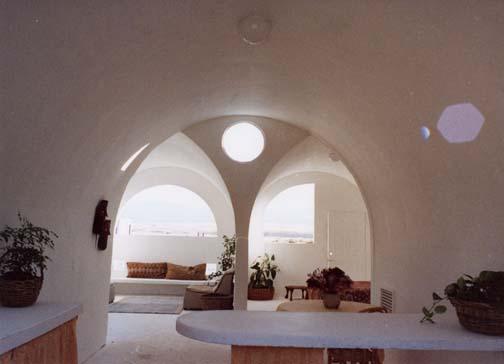
Interior image of Superadobe home from www.cal-earth.org website

The architect Nader Khalili, who has designed habitat for future NASA moon missions, has designed ingenious emergency housing, as well as beautiful homes such as the one in the photo to the left, and public facilities using earth rammed in sand bags. He calls his structures superadobe.

The technology to live gracefully, in harmony with Earth, in deeply comfortable and less costly environments exists today, as it has for millenia.

Earthen structures work well in a variety of climes. I first learned of cob when I read of a six-hundred year old cob house in England. They've been building them there for centuries. See these photos.

There is at least one cob house in rainy Oregon, and some folks in British Columbia give regular classes on building cob there. A good example is Kate's Cob - Mayne Island B.C..

Photo from Groundworks web site at www.cpros.com/~sequoia/cobhome.jpg

To learn how easy--or difficult--it is to build a cob home, check out the tale of this 72-year-old woman, Lois Lewis, who built her own home.

For a capsule view of cob use, read Michael Smith's essay, The History of Cob at Natural Building Colloquiem Southwest.

Thursday, October 06, 2005

Evening replay

It seems I cannot move forward with Rose's next post until I noodle more with Evening. I'm not happy with it--the tempo is off. It's way too long. On reflection, an apartment complex constructed in concentric circles would take too much land, especially on a hillside sloping to a lake. Views would be lost.

The complex needs to be airy, open, and bring more of the forest from which it was hewn into the lives of the folk living there.

S suggests cutting the circles in half.

Of course! Arcs solve so many problems in architecture as well as landscaping. They evoke the circle, wholeness, openness to possibilities, to wind, to storm, to laughter. Arcs embrace without excluding. Thank you, S.

It may be a while before Evening lets me go.

Sunday, September 11, 2005

Gaviotas - A real village

Ordinary exists! Or something very like it, and in the most inhospitable of places--Colombia.

Thirty-some years ago, Paolo Lugari, a native Colombian and son of an Italian immigrant, founded Gaviotas in the broad, inhospitable savannah of Colombia where soil is too full of iron to support food crops and the water table so deep that native populations were forced to drink fetid water much of the year.

At that time, water-borne bacteria killed more people in the savannah than the military, narctoics trafficers, and guerillas combined.

Gaviotas soon became a model experimental community of sustainability, cooperation, and ingenious inventions, including deep wells pumped by children riding teeter-totters, that are being used throughout the world to better the quality of life and lessen the impact of encroaching populations on surrounding environments.

More, Gaviotas has existed for more than three decades without locks, with no police force, with no mayor or city government, and without weapons in a no-man's land surrounded by shoot-to-kill army, guerillas, and paramilitary drug trafficers whose identical guns and camaflouge gear make them all but impossible to distinguish from one another.

More remarkable still, Gaviotas has accomplished the unexpected: they have regenerated rain forest where it had not stood for perhaps a thousand years.

But do not take my word for it. Read a transcript of reporter-author Alan Weisman's 1994 All Things Considered" National Public Radio story following his visit to the remote village. Better yet, read his book, Gaviotas: A Village to Reinvent the World. It reads like a novel and is difficult to set aside.

If you are keen about sustainability, expect to be inspired and amazed.

Friday, September 09, 2005

Something wrong with this picture

A few weeks ago, a high school senior did what graduating students in her town do every year. She posed for her senior picture with a caged tiger. The tiger did what it had not done to seniors in years past. It attacked and killed her.

I grieve for this young woman, for her lost potential, for her family who loved her dearly.

To some it may seem inconceivable, but I grieve, too, for the tiger. The tiger did what wild, predatory animals do. So we killed it.

More and more frequently, we see images of caged animals, brought out for our entertainment, turning on someone and killing or maiming them. Or an animal escapes from its zoo or circus and, cornered and frightened, lashes out against its captors.

A few years ago, a circus elephant, said to be rampaging through the streets of the city in which it escaped, was killed as a preventive measure.

The runaway elephant, surrounded by traffic, shouting humans, and unfamiliar territory, was frightened and unpredictable. So we killed it.

We are fascinated by tigers, elephants, gorillas and roaring lions because they are wild. Why are we offended when they behave wildly. If we put ourselves in harms way, why do we punish the creature who behaved as we knew it might?

We kill them because we can no longer trust them not to kill or maim us.

We think of animals as less than humans, their lives more readily expendable than ours. Often we exploit them for their flesh, for their hide, for a gland we find useful medicinally.

We dare not think of them as sentient beings, capable of creativity and intelligence.

What about intelligence? Just how smart are the wild animals? We know that whales mourn their young and that dolphins use sponges as tools. (See Wanda Tucker's August 20 post, "Non-Human Emotional Intelligence" about a mother whale mourning her calf, and her July 10 post, "Take care of what you love," about dolphins who protect their delicate noses with sponges when rooting fish from the sand.)

From Jane Goodall's work, we have known for years that chipmanzees use tools as well.

John C. Lilly's work with bottlenose dolphins in the late Sixties and early Seventies pioneered the study of dolphins' ability to learn and communicate with language. (If you can get your hands on them, see his books The Mind of the Dolphin: A Non-Human Intelligence , and Communication Between Man andDolphin: The Possibilities of Talking With Other Species.

Still controversial, Lily's theories nevertheless spawned the Navy's use of dolphins as weapons, which is still occurring today.

Then there is Koko, the gorilla who learned sign language and communicates with her friends and handlers, celebrates birthdays and holidays, nurtures pet kittens, and participated in the first interspecies web-chat, the transcript for which suggests many questions about the relationship between a captive animal and the scientists who study them.

When we choose to interact with wild animals, animals whose bodies are built to tear, to dismember, to kill creatures as large as ourselves, we risk our very lives. Must we blame the animal when it behaves as it was made to behave?

I pray for peace and strength in the hearts of the family who miss their beloved daughter, sister, niece, grandchild. I pray they have memories of their darling to last a lifetime, and that through the miracle of grace and healing, their suffering is eased. They will feel this tragedy for the rest of their lives. I pray succor comes to them when they need it most, and again and again.

I pray we humans learn ever deeper respect for the creatures with whom we share this beautiful planet, and that we find it in our hearts to deepen our understanding of their lives and purpose here.

To all the individuals who devote their lives to the well-being of species not human, I give deepest gratitude.

Thursday, August 25, 2005

Pay it forward

The vision of Ordinary is my sanity in an increasingly violent world. Sometimes, though, it is hard to keep the vision clear and near.

Not long ago, an old family friend was killed by her husband. There had been no history of abuse in the family according to news reports. The family tells us that the 72-year old retired professor who killed his soul-mate and wife of many years, herself a retiring professor, suffered from dementia.

It is terrifying to imagine that a disease of the brain could render me so senseless that I might bludgeon my dearest loved to death. How is this possible?

We are a culture that celebrates violence. Murder is the theme of at least one television show on the major networks (never mind cable), almost every hour. The more graphic and "real" the bloodletting, the better.

Ignore fiction, stick to real life, and all I have to do is watch the news or tune in online for a smorgasbord of war, drive-by shootings, and yes, extraordinary examples of family violence, over and over and over again.

These past weeks, I feel increasingly surrounded by violence. Bombings in Iraq, Israel, Palestine, Egypt, London. Gang-banger shootings on trains in my own city.

People are angry. People are greedy. People want to get even. People need control.

For some, so the television news magazines indicate in interviews with killers, violence is what they do, like picking their teeth or eating Cheetos.

Closer to home, though not so graphic--and therefore, not so entertaining--is emotional violence. A man I know, a good man trying to do the right thing for his company, recently demoted an employee because, he said, he felt his division had become "stagnant" and needed "shaking up."

The employee, loyal and dedicated, built his department from the ground up and must now train his successor. Had my friend attacked his employee physically, I doubt he could have done more damage. Will it help the bottom line? Will they grow bigger faster?

Look closer. Examine my own life. My bookshelves contain numerous who-done-its. I have read most of them, some more than once. A quick, easy read, I call it, when I want to escape. Imagine! I, who work for peace, escape to violence--to human hatred, betrayal, and loss--as entertainment.

Look closer still.

More and more, I am aware of the ways I participate in or choose violence on a daily basis.

Frequently, I jockey for position in the commuter train queue, making myself big to keep another from edging me from the front and center spot. If I am lucky today, that spot will get me on the train first so I can snare a rare open seat.

You think this a small thing? It is pure aggression and greed. When I become aware of my behavior in these moments, frequently my heart is racing, sometimes pumping so hard that my head hurts with each beat. Often, my fists are clenched, my jaw tight.

Too often, I sacrifice inner peace to create a personal advantage for a seat.

Friends and family argue that conflict is human nature, that it's in our genes, a hold-back to survival of the fittest, or simply a part of us because we are animals too, animals with teeth, brains to make weapons, instinct to guard our territory.

Perhaps that is true.

Perhaps that is a good excuse for choosing not to examine the way we do violence to ourselves and to others in our daily lives. After all, we have something other animals are believed not to have: free will and choice.

I'll tell you this. There have been plenty of times that I, bone-tired, got lucky and grabbed a seat on the train. Then someone shuffled on the train whose weariness was so deep, so profound, that I was up and offering my place almost without thought.

Not everytime, but often enough, they have responded with a gratitude that strengthened me, and I stood the twenty-to-thirty minute ride home energized, with a smile on my face.

Other times, I have been the one holding the bar with a fatigue so great it was all I could do not to swoon, and some individual has risen and said, "Please, take my seat. I'm getting off soon."

I wonder if they know what comfort their kindness brought, lasting long after the ride.

Kindness stays.

What was it that fellow said--"Pay it forward."

Kindness pays it forward.

You never know how far reaching a simple act of kindness in a rather mundane moment might be.